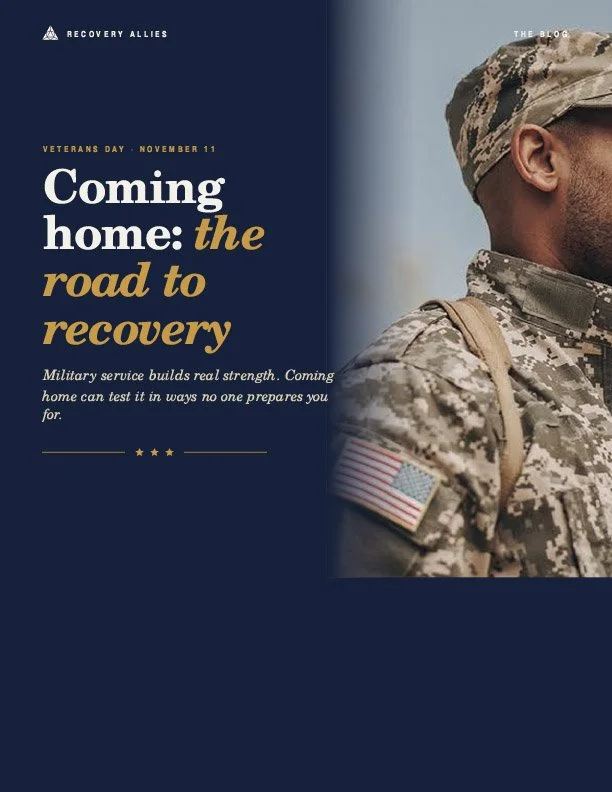
Military service builds real strength. Coming home can test it in ways no one prepares you for.
Every year on November 11, the United States pauses to honor its veterans. Many other countries mark the same day as Remembrance Day or Armistice Day. For many veterans and their families, it can also bring up hard memories and a transition home that never quite felt finished.
At Recovery Allies, we work with veterans and military families in Seattle, Los Angeles and across the country. The skills that serve people well in uniform can make it harder to reach out once they're home. We've also seen how much changes when they do.
Who Our Veterans Are, and What Many Carry Home
15.7 million U.S. veterans. 1.7 million are women. Nearly 1 in 3 served after 9/11. 7% to 29%: Lifetime PTSD affects about 7% of all veterans, and 29% of those who served in Iraq and Afghanistan.
1 in 3 veterans in treatment for a substance use disorder also has PTSD.
1 in 4 combat-zone veterans binge drank in the past month.
1 in 8 combat-zone veterans had an alcohol use disorder in the past year. About 1 in 5
had a mental illness.
Around the World
November 11 is Veterans Day in the U.S. and Remembrance Day or Armistice Day in many other countries, where the red poppy is worn in honor of those who served.
Why Coming Home Is So Hard
Military life comes with a clear purpose and a team that always has your back. Leaving it can mean losing both at once. Many veterans describe feeling out of place in civilian life, unsure how their skills translate, or disconnected from people who don't understand what they've been through.
Add injuries that still hurt or nights without real sleep, and alcohol or other substances can start to look like a way to cope. For some, drinking was already part of military culture. Over time, what began as a way to unwind or get some sleep can become something harder to stop.
When Strength Gets in the Way
The same values that make service members strong can make asking for help feel impossible. Self-reliance and "mission first" thinking are powerful in the field. At home, they
can turn into "I should be able to handle this on my own."
Needing support isn't a weakness. The discipline and resilience built in service can become real assets in recovery.
Research suggests that treating PTSD and substance use together can be especially effective.
Signs a Veteran May Be Struggling
Drinking more often or more heavily, especially to sleep or calm down
Pulling away from family, friends or fellow veterans
Irritability, anger, or feeling constantly on edge
Nightmares, flashbacks, or avoiding reminders of service
Relying on pain medication more than prescribed
Losing interest in work, hobbies or the future
For Families and Friends: How You Can Help
Start with a simple, judgment-free check-in. You don't need the perfect words. Listen more than you talk, and avoid pushing for war stories. Offer practical help, like making a call or going to an appointment together. And take care of yourself, too. Supporting someone you love is meaningful work, and it's not something you should carry alone.
You Don't Have to Make the Trip Alone
Taking the first step toward treatment can feel like the hardest part. Our trained Recovery Specialists can accompany veterans as they travel to or from treatment. Through case management and recovery companion support, we also help with what comes next, from settling back in at home to building a routine that supports long-term recovery.
To every veteran: thank you for your service. You've been there for others. Let us be there for you.
Ready to Take the Next Step?
Sources
U.S. Census Bureau, "Veterans Day 2025" (2024 ACS)
VA National Center for PTSD, "How Common Is PTSD in Veterans?"
U.S. Department of Veterans Affairs, via GetSmartAboutDrugs.gov
SAMHSA, "Mental Health and Substance Use among Veterans," NSDUH Data Spotlight (2022–2024 data)
VA, "Veterans Crisis Line: Dial 988 Then Press 1"